


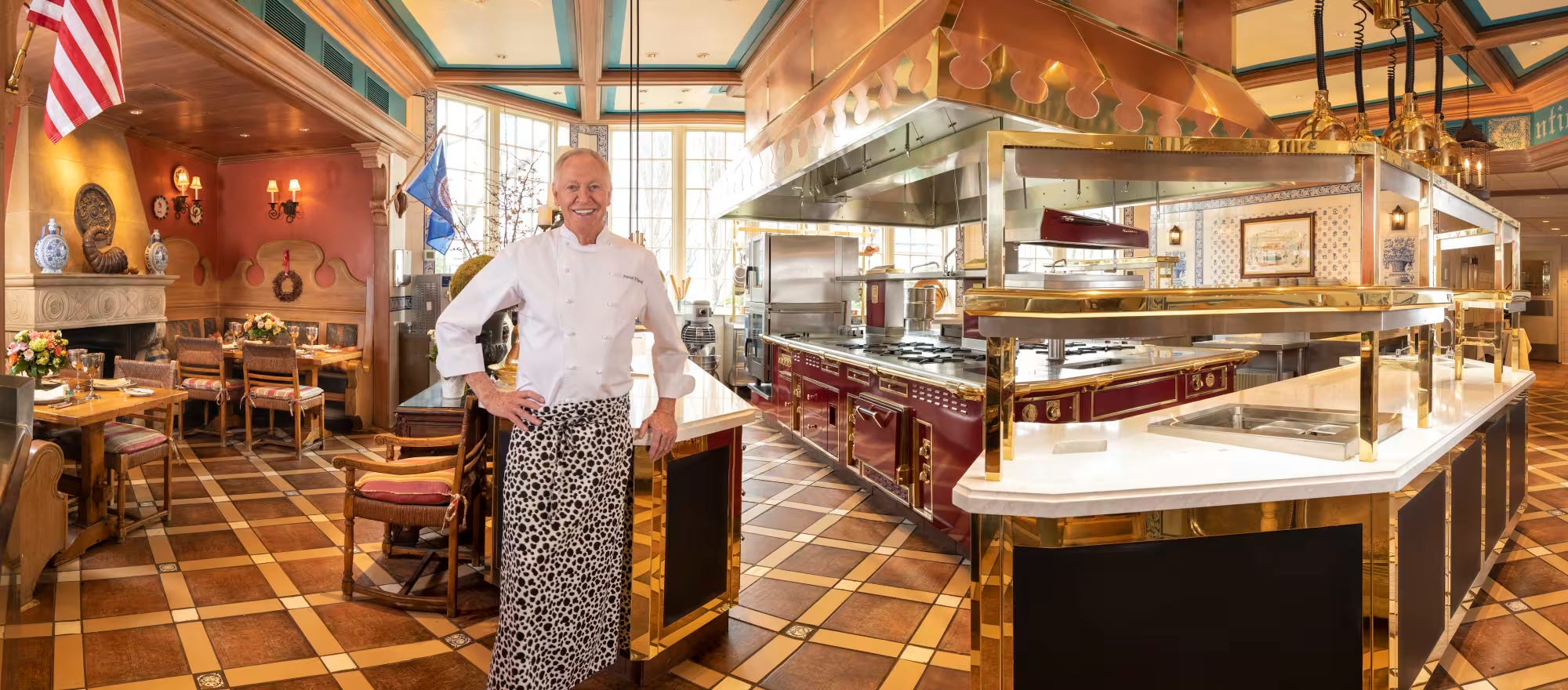
In the same way that the Inn at Little Washington is designed to overwhelm guests with splendor and perfection, interviewing chef Patrick O’Connell is like a (3 Michelin star) all-you-can-eat buffet, truly an embarrassment of riches for a journalist. Ahead of the release of his new memoir, “Main, Middle & Gay,” I recently had the pleasure of spending an afternoon on the phone with him for the second time, for this profile on TODAY, and once again found it nearly impossible to choose a focus for my story. I mean, this guy has cooked hamburgers for Julia Child’s birthday party and scrambled eggs for Queen Elizabeth! And all that after surviving a traumatic childhood as a gay kid who was fueled instead of deterred by the obstacles in his way. In fact it’s hard to think of a more unprepossessing set of circumstances than the ones O’Connell was born into, and what he made out of his life is a testament to his tenaciousness.
He talked to me about his unlikely journey to becoming one of the leading figures in the history of American cuisine and why he’s at peace, now, with being seen. I wanted to share more from our conversation because he has a lot of superfans out there and so much of what he said has really stuck with me, especially his philosophy on achieving success. Read on for his pioneering hospitality mantra, his thoughts on Anthony Bourdain, and some incredible shade thrown at American yogurt.
There’s stuff in here that’s so sad and hard to read, starting with you being targeted as a very young boy and enduring a lot of assault. And then you call yourself a delusional smart ass, even as a young teen, which is kind of amazing to see that you had confidence even after all of that trauma. Would that kid ever have thought you’d be writing a memoir like this?
Anger aged to a kind of resilience. I think it can be a tool. And it was effective for me. The biggest revelation for me in writing the book was to understand that I haven’t changed at all since age five. I’m still seeing life in the same way. I’m still dreaming in the same way. It’s just that now, it’s in reality. My belief is that people’s personalities are pretty clearly formed by the time they’re six, eight, or 10 years old.
Speaking to other people, they say, How did you remember all that stuff? And I thought, I never forgot it. And then I realized that the norm for most people seems to be, they can’t remember the early childhood. It’s faded or shut out in some way. Every moment of my life was indelible, and still is. And it’s partly because I chose to see it as a film, perhaps in a protective way. Now it is a fabulous movie. You don’t forget a really good movie.
You say you’re still the same person, but are you still fueled by anger?
Fuel can come from anywhere. I’m fueled by being underestimated.
But surely you’re not still underestimated.
Well, I’m also fueled by being told why either I can’t do something or why it won’t work.
Are people really still telling you that?
Yeah. I mean, the dreams and the ambitions have become, in some people’s minds, perhaps a little more grandiose than they were in 1978.
What does it mean to be the pope of American cuisine? Is that something you like being called?
That came out of an account that was written by Robert Mondavi, who had a strong Italian Catholic background. And once he gave me that title, we decided to have fun with it. We decided to emphasize the kitchen as a sort of spiritual place, a different experience from the dining room, because people also dine in the kitchen here. And so you’re welcomed into the kitchen by an acolyte with incense and in robes. And the chefs are lined up to receive you. You have a ceremony of hand washing in rosewater, and you drink out of beautiful silver goblets. And you’re sort of transported into a different realm and made to feel like royalty.
It’s its own kind of theater that you brought to the kitchen, as a former theater kid.
Exactly. It’s all a performance. We’re not taking ourselves too seriously, but the effect it has is amazing.
We do this every night, but the guests are usually there celebrating something special. And they say incredible things to us, that they hadn’t been welcomed that way or made to feel that important since their wedding day.
I think it emphasizes to our staff how simple it is to increase people’s self-esteem. We need that more and more and more, and we’re getting it less and less and less. And it’s so simple. To begin with, it doesn’t cost a thing. And it just kind of casts a spell.
One of the saddest things about our industry is that people are missing the point. I think there are places where you get that feeling, but we have tried to make it the entire culture here, way before people were writing books about it and that sort of thing. Most high-end, 2 or 3 star restaurants in America, are aware that people aren’t coming because they’re hungry. They want a little more than that. Instead of it being about the guest, you are made to feel sometimes that you are lucky to have a seat, and now we will all just sort of bow to the chef in his presence, and it will be about the restaurant instead of about you. My desire from day one, because I was seeing life as a movie, was to create a set where you could feel that you could enjoy the play of your own life. But most importantly, you would be the star.
We have a simple mantra here. All you have to do in this business is: be the guest. Meaning, you have to get inside the guest’s head, feel as the guest is feeling.
It’s sort of an erasure of personhood from the server’s point of view…
Exactly. It’s how you regard the guest, because our ultimate goal, and how we’re evaluated, is how we make people feel. Everybody wants to be the most important person in the room. That’s hard when you have 75 or 80 people in the room! But if you regard each one with singular intensity and focus, that will stay with them.
You said something about food back in the 70s or 80s being fancy for the sake of being fancy. How do you subvert that kind of cooking at the Inn?
There was the perception here that restaurant food did not taste as good as grandmother’s because it was all about how fancy you could make it. And the taste, the flavors were secondary.
And that is not your approach.
No, God, no. We call the style of cooking we do here, deceptive simplicity. So, I was thinking this morning, it actually is parallel to what the publisher called the voice in my writing. It’s deceptively simple. It feels unembellished, as straightforward as a child’s, but it’s actually very, very carefully crafted.
You’ve earned all the awards, you’ve cooked for royals and world leaders and Julia Child. What recognitions mean the most to you out of out of everything?
Well, in our business, we never actually arrive. We are proving ourselves, going from zero, every single night. You can be just as thrilled [to match expectations] as you might be with a prestigious award. It’s all very touching, but we’re here to make people happy -- every kind of person, ordinary people, happy every night. That’s the goal, and that’s the award when it happens.
There’s another chef who had a wayward youth and then kind of a rock ‘n roll experience finding his calling, which would be Tony Bourdain. How do you feel about the way his character is kind of embedded in pop culture right now? Do you see any parallels?
I knew him, and I was fascinated by his trajectory. I think success has a lot to do with bringing all of your talents together and not having to choose one above the other, but integrating them.
At what point in your career did you feel like you could do that, wholly as yourself?
Well, this is the first opportunity I’ve had to write this kind of a book, to use words to describe what we are, who I am. I think, as with Tony, we went from being the ‘rough and ready’ cook, to becoming something so much more. And by tapping all of his other talents and bringing them together – well, let’s just say no one else has ever equaled his travelogues.
Do you think that a self-taught chef nowadays could achieve the kind of success that you did, and to a different extent, he did?
The dining public in America today knows so much more about food. We are spoiled, so spoiled for choice. The sad thing is that Americans have always been known for choosing choice above quality. You’d rather have 10 choices, it seems, than two exquisite ones. I remember in my youth, being on a train in Europe, and everybody eating yogurt. We didn’t have yogurt yet in America. Can you believe it? I had a taste of it, and it was glorious. It tasted so nutritious and so healthful, but full of wonderful flavor. Within about five years, back home, it had caught on big time. But what was the first thing they did with yogurt? Make a million. 26 flavors. All of them tasting plasticky, full of artificial crap and color. In Greece, in France, you don’t even think about how many kinds of yogurt do you have. You just want the quality. We have 26 flavors in the supermarket here, but they’re all terrible. They’re pandering to what they think is America’s necessity for color and sweet. In the early eras of my coming on the scene, everything was over-sweet. And we had to get beyond that. Still, not a week goes by that I’m not saying, to the pastry people, and our bakery, Can you use less sugar in that? Can you make that cookie less sweet?
Because I lived on a farm before we opened the restaurant, I only ever used honey as a sweetener. On opening night, we had chocolate creme caramel. But I caramelized honey and didn’t use any sugar in the custard. And it was glorious, rich and subtle, full of nuance because of the flavors of the honey. And I realized, wow, that was close to 50 years ago, and people are still figuring it out today.
You were talking about worrying about the impact of this book. Can I ask what you think the biggest headlines will be? And if that’s different than what you wish people would take away from it?
Well, the wonderful thing about it is it’s not one thing. It’s three or four narratives combined. And most importantly, it’s humorous. There’s nothing funnier than truth and reality. I mean, everybody’s life is wacky in some way or another. This is not only an improbable story, it’s a wacky one. And there’s the usual amount of wistfulness and tragic happenings. But, for the most part, they’re all overcome.
I don’t think anyone would want to trade places. And that’s a good thing. I think people who see a film and then want to be just like the protagonist or whatever, will think twice. You brought up Bourdain. I think so many people in the food world not only looked up to him, but were envious of him, of the fame he achieved through food, not really as a chef, but that he created a singular identity by combining all of his talents. But clearly, no one would say, I wish I were him, or I wish I had done that, because of the tragic ending.
There’s a heavy, heavy sacrifice to any kind of success, but as we talked about earlier, the fact that we have to do it again tonight... And if it’s not good, everything that’s gone before, just goes to the toilet.
The emperor must keep his clothes on.
Is it a challenge that still thrills you every day?
Well, the formula is simple. You can’t do as well as you did yesterday. You have to do better. It takes a big imagination to keep raising the bar when you’re already at the height or the summit of the restaurant world. Everybody on board has to believe it and strive. So, you learn to kind of see who might be having a difficult day, and you basically have to make a connection each day with every person in the kitchen to inspire the troops with this feeling of, you know, let’s make it happen together.
You mentioned the mission of your other books. What makes you feel like ‘mission accomplished’?
You know instinctively when you had a great night, or produced a magnificent dish. Your excitement is palpable and translated into the food. So newness is a great drug here, and we have to do something, regardless of how small, each day that is new -- that we, in other words, give birth to.
I happen to love flowers, because they make everything a special occasion. You wouldn’t probably go to a wedding with no flowers. Our arrangements reinforce the idea that this is a major life occasion. Every day, the flowers have to be impeccable — dramatic and stunning and fabulous. It sends a subliminal kind of idea that everything here is just totally fresh. I feel like they represent the fact that if the flowers, which only have a life expectancy of two days, can possibly look that immaculate and glorious, imagine how good the food is going to be.
You have this theory about locations that ties into the book’s title. How can others find where they’re meant to be the way that you did at the intersection of Main, Middle & Gay?
One starting point is to eliminate money from your choice. If I did not need any money, where would I be drawn to? People often gravitate toward water or away from water. I gravitated away from water, toward the mountains. The soft rolling hills made me feel protected; I’m just so grounded here. So, the second question is, visit places, and see how they make you feel. When I’m traveling, I always ask myself, Could I live here?
Today, my dog got me up at 5:40 am. He is full of nervous energy. So we went out. He ran off into our beautiful meadow. And I looked up and there was the Big Dipper, and it was like, Wow. I wonder how many people are appreciating that at this moment. I mean, I felt so grateful for being able to live here.
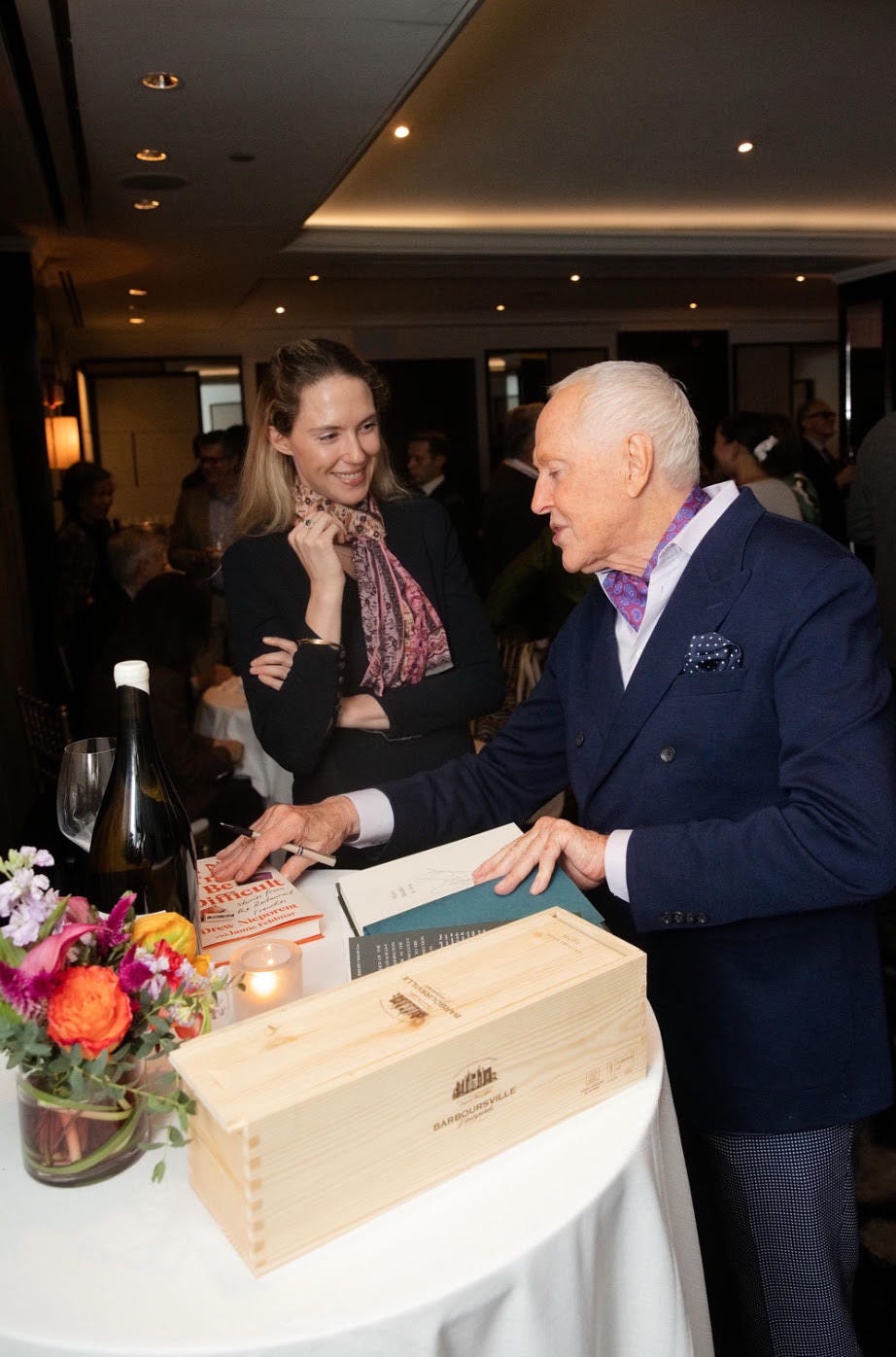
Deepest thanks to chef Patrick O’Connell for being so generous with his time and hard-earned wisdom!
Interview lightly edited and condensed for clarity.
Glorious. https://youtu.be/2VTj3B0nZoU?si=ruy5nFXQQl0jYatV